
Las Vegas Woman Urges Knowledge, Self-Advocacy and Mental Health After Cardiac Event; Launches Business to Help Others
February 24, 2026
The beginning of 2021 was challenging for Las Vegas resident Diane Friedman. She’d lost friends, relatives and her three beloved dogs. “I started not feeling well,” she said. “Because I have a history of anxiety, it was dismissed as a panic attack. I had a physical and my annual well-woman check-up and while my cholesterol was a little high and I had shortness of breath, no one suggested blood work. The consensus was, ‘You’re turning 50. Welcome to menopause.’”
Two weeks later, on May 25, Diane experienced a wave of nausea during lunch, dealing with it throughout the day. In the night, however, she awakened with multiple symptoms – chest pain, hyperventilating and vomiting.
“I thought it was food poisoning and a panic attack. I went back to sleep thinking, ‘This is how I’m going to die.’ But I woke up again, thinking I was a hypochondriac. My primary care physician advised me to take some anti-anxiety medication, even when I told him about the chest pain and vomiting. I didn’t look like a typical heart attack patient,” she said.
But after feeling a continued heaviness in her chest, she had an EKG at her primary care physician’s office the Friday before Memorial Day weekend. It came back abnormal along with the advice, “If you feel worse, go to the ER. Otherwise, go to your cardiologist.”
Treatment at Summerlin Hospital
When she connected with long-time Las Vegas cardiologist Dr. Allan Stahl on June 2, he delivered the news – Diane had a heart attack on May 25 and had been walking around, working and living her life while the first diagonal branch of the left anterior descending (LAD) artery was 99 percent blocked.
Dr. Stahl met Diane in the Summerlin Hospital emergency department, handed her off to the ER team and within 90 minutes, interventional cardiologist Thomas Lambert, MD, performed angioplasty, placing a stent to open her clogged artery, immediately improving blood flow to Diane’s heart.
“Summerlin Hospital saved my life,” she said.
The cardiac blues
However, the journey wasn’t over. Physically, Diane felt fine, leaving Summerlin Hospital the next day. “Emotionally, it crushed me,” she said. “Having a heart attack isn’t just your heart going through something. Your brain has to process it. You realize you could have died. You wonder why you didn’t. You try to figure out how to move forward.”
Diane wasn’t alone with those types of emotions. Informally known as the “cardiac blues,” heart attack survivors might feel scared, alone or simply different from their pre-heart-attack self. The American Heart Association notes survivors might feel fear, anxiety, loneliness, depression, anger and sometimes, hope. The key is to understand your feelings, and if needed, seek help.
That’s exactly what Diane did. While the idea of discussing her mental health publicly was daunting, “It’s okay to be your own advocate. It’s okay to get answers,” she said.
And she says it’s good to show others that seeing a therapist can help individuals work through issues that are preventing them from living their best lives. She has received hugs, notes and comments, thanking her for sharing her journey and the importance of seeking care for not only her physical health but also her mental health.
Post-procedure, Diane was fully supported by her husband of 16 years, Charlie, as well as her mini Australian shepherd and emotional support dog, Otis.
Outpatient cardiac rehab
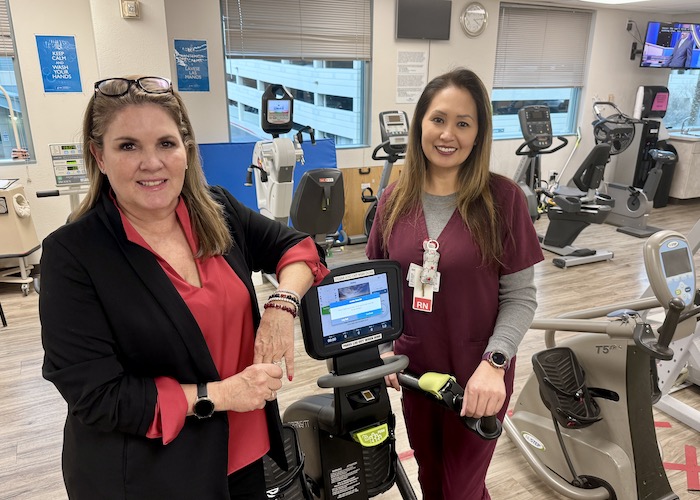
One other group played a key role in her recovery – the outpatient cardiac rehab team at Summerlin Hospital. “They helped me so much. Sometimes I couldn’t stop crying and Ellie, one of the cardiac rehab nurses, would remind me it’s okay to cry. Through their guidance and vigilant monitoring, the cardiac rehab team also gave Diane the confidence to support her heart health, pushing herself but not overdoing it for 12 weeks.
Sharing her story
Despite all the positive support, there was one more hurdle to overcome – having lifesaving medication with her around-the-clock. So, Diane launched a small business, Enusia, from her kitchen table. “I need to carry nitroglycerin with me in case of an emergency, so I designed a bracelet to discreetly carry essential medication. It’s pretty, it’s functional and no one needs to know I’m carrying medication.”
With more than two dozen styles to choose from, the bracelets are designed for men and women, feature a medical-grade stainless steel container to hold medications of multiple sizes, and can be worn wherever needed – work, shopping, sporting events – for easy access to vital medication. Diane has even created custom bracelets for football fans and area charities.
Throughout the month of February, Diane has made it her mission to share her story as much as possible. She was a featured storyteller at the Las Vegas Go Red for Women luncheon on February 20, 2026.
Her message? Cardiovascular disease remains the leading cause of death among women. Know your body. Be your own best advocate. Seek out the care and answers you need because people experiencing heart attacks come in all shapes, sizes, races and ages.
Heart attack symptoms
- Chest discomfort – uncomfortable pressure squeezing, fullness or pain
- Discomfort in other areas of the upper body including arms, back, neck, jaw and stomach
- Shortness of breath, with or without chest discomfort
- Other signs: cold sweats, nausea, rapid or irregular heartbeat, feeling unusually tired, feeling lightheaded
Heart Care at Summerlin Hospital
Learn more about cardiology services at Summerlin Hospital →